Commercial · Gladstone, MO
Concrete warehouse and industrial floor contractor in Gladstone, MO — floors built for operations.
Warehouse and industrial floors face different demands than residential flatwork — repetitive forklift traffic, high-density static loads, and flatness tolerances that determine whether narrow-aisle equipment can operate safely. Getting the PSI specification, F-number requirements, and joint layout right before the pour is what separates a floor that holds up for 30 years from one that develops problems in the first few years of operation. We install concrete floors for warehouses, distribution facilities, light industrial buildings, and commercial spaces across north Kansas City.
Free Estimate
Tell us about your project
We respond within one business day.
The Finished Result
A floor that performs under the loads your operation puts on it.
Warehouse and industrial floors face different demands than residential flatwork — repetitive forklift traffic, heavy static loads, chemical exposure, and the need for surface flatness within tight tolerances. Getting the specification right before the pour happens is what separates floors that perform for 30+ years from floors that crack and scale in the first few years of operation.
Request Free Estimate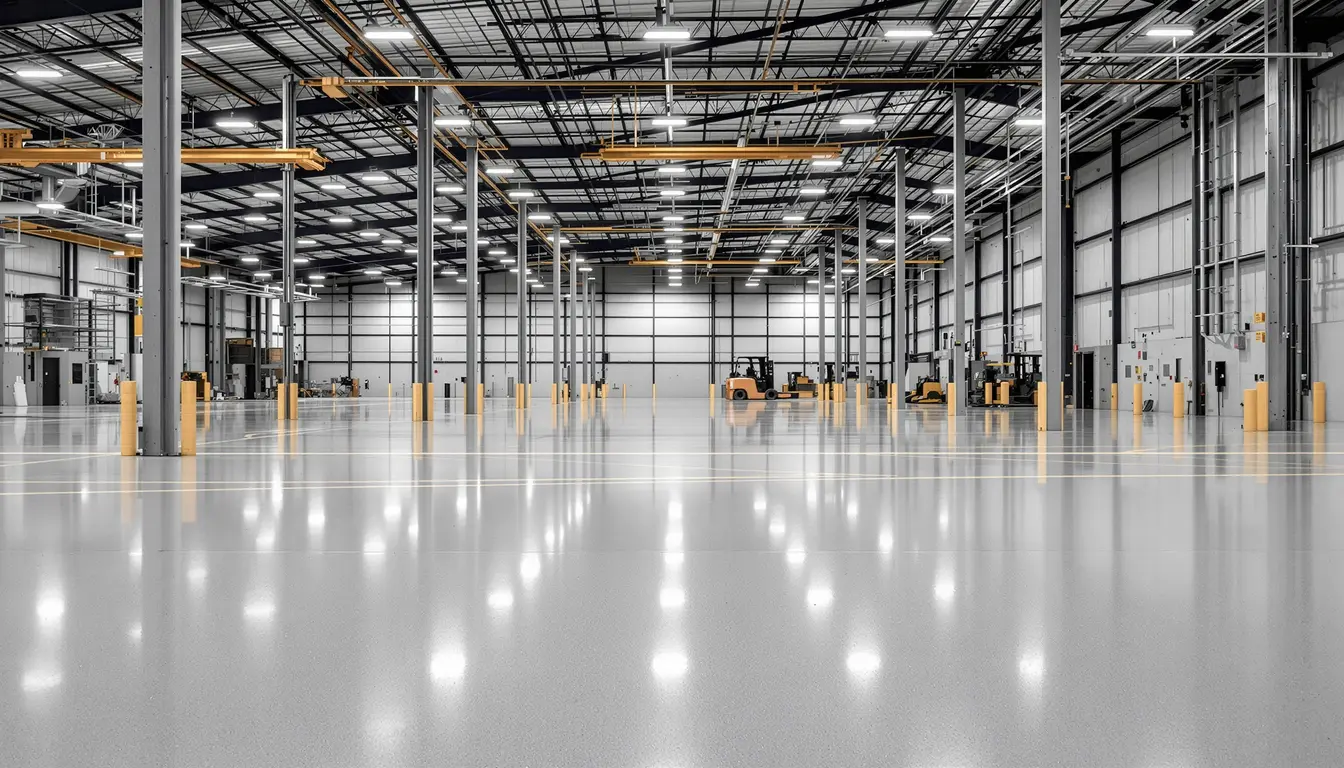
Service Overview
What warehouse and industrial floor work includes
Industrial floor projects typically involve large slab pours on prepared sub-base, with requirements that are more stringent than residential flatwork. Concrete PSI, F-number flatness specifications, vapor barrier under the slab, joint layout and spacing, and surface finish are all part of the specification.
These projects require careful coordination with the building construction schedule, other trades working in the space, and the operational start date. We assess each project before committing to a scope and timeline.
Common reasons for this service
- New warehouse or distribution facility. Floor slab for a new construction warehouse, distribution center, or logistics facility.
- Manufacturing floor installation. Concrete floor for a manufacturing facility — with the PSI and flatness spec required for production equipment.
- Commercial building floor replacement. Replacing a deteriorated existing floor that no longer meets operational requirements.
- Facility expansion slab. Pouring new floor area for a building expansion — connected to the existing floor and at the same finished elevation.
- Cold storage concrete. Slab installation for refrigerated or frozen storage facilities with insulation and vapor barrier requirements.
What Matters
The technical factors that determine whether this project lasts.
These aren't variables that show up on a finished surface — they're what's underneath it.
Concrete PSI for the load
Standard commercial floors use 4,000 PSI. Heavy forklift traffic and high-density storage typically require 4,500–5,000 PSI or higher. Load requirements drive the specification.
F-number flatness specification
F-numbers define how flat and level the floor must be. High-rack warehouses with narrow aisle forklifts require tight F-number specs. Random traffic warehouses are less demanding. The operational use determines the required specification.
Sub-base preparation
Industrial loads require well-compacted, uniform sub-base. Variable compaction leads to differential settling under heavy loads.
Vapor barrier under the slab
Industrial floors typically include a vapor barrier below the slab to prevent moisture transmission from the ground that can affect equipment, flooring materials, or product.
Joint layout and spacing
Control joints in large industrial slabs are laid out in a planned grid — spacing determined by slab thickness. Armored joints protect joint edges from forklift wheel traffic.
Surface finish options
Warehouse floors are typically steel-troweled smooth for forklift operation. Food processing and some manufacturing floors may require different finishes or surface treatments.
North KC Conditions
How Gladstone's soil and climate affect warehouse & industrial floors.
Clay sub-base variability
North KC's clay sub-base can be variable — important to assess bearing capacity uniformly across a large slab footprint before industrial pours.
Large slab thermal movement
Large industrial slabs expand and contract with temperature. Joint layout and spacing account for this movement.
Moisture from clay soil
Clay soil in north KC retains moisture that can transmit through slabs without vapor barriers. Industrial floors with moisture-sensitive operations require proper vapor management.
The Process
From your first call to the finished project.
Submit project details
Provide facility type, approximate slab area, load requirements, and schedule context.
Project assessment
We assess whether the scope, specification, and timeline fits our current capacity and capability.
Specification development
PSI, F-numbers, joint layout, vapor barrier, surface finish — specified before pricing.
Written estimate
Fixed price with complete specification.
Sub-base, pour, finishing
Sub-base prepared and tested, vapor barrier installed, forms and screed set, concrete placed and finished to spec, joints cut.
FAQ
Common questions about warehouse & industrial floors in Gladstone, MO.
What PSI concrete does a warehouse floor need?
Standard warehouse floors typically use 4,000 PSI concrete. High-density storage racking and frequent heavy forklift traffic often require 4,500–5,000 PSI. The correct specification depends on your operational loads.
What are F-numbers for concrete floors?
F-numbers (FF for flatness, FL for levelness) measure how flat and level a concrete floor surface is. High-rack warehouses with narrow-aisle VNA forklifts require FF35/FL25 or better. Random traffic warehouses are typically FF25/FL20. The operational requirement defines what you need.
How do you prevent forklift damage to concrete joints?
Armored joints — metal edge protection installed at control joint locations — protect joint edges from the repetitive impact of forklift wheels crossing the joint. This is standard for high-traffic forklift operations.
How long does a concrete warehouse floor need to cure before operations start?
Foot traffic is typically possible after 24–48 hours. Light equipment after 7 days. Full operational use with forklifts should wait 28 days for full concrete strength. Project schedules need to account for this curing timeline.
Can you pour a new slab to match an existing floor elevation?
Yes. Connecting a new slab pour to an existing floor at a matched elevation is common in expansion projects. We address the joint at the connection, drainage integration, and transition detail at that boundary.
Serving north Kansas City
Ready to discuss your warehouse floor project?
Free estimates for warehouse & industrial floors across Gladstone and north Kansas City.